HPE6-A85 Practice Questions: Are You Ready for Real Campus Network Scenarios?
A network engineer may spend years working with switches, VLANs, routing, and wireless infrastructure and still encounter unfamiliar problems when moving into an Aruba campus environment. The fundamentals transfer, but configuration methods, management workflows, and troubleshooting decisions require additional familiarity. For candidates preparing for HPE6-A85, the challenge is identifying which skills already carry over and which need more focused preparation.
General Networking Experience Has Its Limits in an Aruba Environment
Cisco experience provides a useful foundation for HPE6-A85 candidates, particularly in switching, IP addressing, routing, and network troubleshooting. The problem is assuming that familiarity with one vendor’s configuration automatically translates into proficiency with another.
Consider VLAN configuration on Aruba CX switches. An engineer who understands access and trunk ports should have little difficulty grasping the underlying concepts. But when working with tagged and untagged VLAN membership, interface configuration, and traffic forwarding, the engineer still needs to understand the Aruba implementation.
That distinction matters when troubleshooting. If a workstation cannot communicate with another network, knowing what a trunk port does is only part of the investigation. You also need to interpret the actual interface configuration, confirm VLAN membership, and follow the traffic toward its gateway.
Management introduces another gap. Candidates accustomed to configuring individual switches through the CLI may have limited exposure to Aruba Central. Device onboarding, configuration groups, monitoring, and network health reporting require familiarity with a different operational workflow.
Wireless experience can be equally misleading. Configuring an SSID is not the same as understanding why clients experience intermittent connectivity. RF interference, channel selection, signal quality, coverage, and authentication can all affect the result.
These gaps depend heavily on previous work experience. Someone who regularly manages Aruba switching may need more preparation in WLAN and centralized management, while a wireless specialist might find device provisioning and troubleshooting less familiar.
Your study priorities should reflect that background instead of following a generic networking revision plan.
What HPE6-A85 Practice Questions Should Actually Test
The current HPE6-A85 exam data card organizes the examination into five sections. Their weightings reveal where candidates should spend the most preparation time.
| Exam section | Weight |
| Plan the Solution | 13% |
| Configure the Solution | 32% |
| Operate the Solution | 22% |
| Troubleshoot the Solution | 25% |
| Optimize the Solution | 8% |
Configuration carries the largest weighting, followed by troubleshooting and operation. Together, these three sections account for 79% of the exam. That makes practical understanding of deployment, ongoing management, and fault isolation particularly important.
The five sections also provide a better way to judge practice materials. Questions should help you understand the work involved at each stage of a campus access solution, rather than simply test isolated networking definitions.
Plan the Solution: Turn a Design Into an Implementation Plan
The planning section covers analyzing the current environment, interpreting an architect’s high-level design, creating a low-level design, and preparing for implementation.
This requires more than recognizing network components in a diagram. Candidates need to understand how the proposed solution relates to the environment in which it will be deployed.
For example, a high-level design may show the intended campus architecture, but implementation requires more specific decisions. You need to understand what information must be gathered from the existing environment and how the design should be translated into an actionable plan.
Practice questions in this area should test whether you can distinguish between understanding a design and preparing the details needed to implement it.
Configure the Solution: Understand the Deployment Sequence
At 32%, Configure the Solution is the largest section of HPE6-A85. Its objectives cover device onboarding, device provisioning, solution deployment, and solution validation.
These activities are related, but they are not interchangeable. Onboarding brings a device into the management environment. Provisioning prepares it with the required configuration. Deployment puts the solution into operation, while validation checks whether it works as intended.
Aruba Central and Aruba CX configuration workflows provide useful context for understanding these activities. Candidates should be comfortable with the purpose of centralized management, device configuration, and the checks required after deployment.
A useful practice question should test whether you can identify the appropriate stage of the process. If a device has been onboarded but has not received its intended configuration, for example, the issue is different from a deployment that has completed but has not passed validation.
This is also where experience with another networking vendor can create false confidence. Familiarity with general switch configuration helps, but it does not automatically establish knowledge of Aruba’s device onboarding and provisioning workflows.
Operate the Solution: Look Beyond Initial Deployment
The Operate the Solution section accounts for 22% of the exam. It covers monitoring and reporting, firmware updates, basic ongoing configuration changes, and documentation.
A campus network still requires attention after deployment. Candidates should understand how operational information is reviewed, why firmware maintenance matters, and how routine configuration changes fit into ongoing network management.
Aruba Central is relevant here because centralized monitoring can help administrators review network health. Wireless monitoring also requires more than checking whether an access point is online. Client experience, signal conditions, and available test results may provide additional information about network performance.
Documentation is another part of the operational process. Configuration records and maintenance history help establish what has changed and provide useful context when an issue occurs.
Practice questions should therefore test operational decisions, not just recognition of management product names.
Troubleshoot the Solution: Find the Scope Before Choosing a Fix
Troubleshooting represents 25% of HPE6-A85. The official objectives cover basic troubleshooting methodology, determining the issue scope, physical-layer troubleshooting, L2–L7 troubleshooting, and implementing and validating a resolution.
This is where candidates need to think through a problem instead of jumping to a familiar command or protocol.
Suppose a workstation cannot reach a server. The first step is not automatically to change its VLAN or gateway. You need to establish the scope of the issue. Is one device affected, or are multiple users experiencing the same problem? Is the problem physical, related to switching or routing, or occurring at a higher network layer?
The distinction between physical-layer and L2–L7 troubleshooting is particularly useful. A damaged cable or failed link requires a different investigation from incorrect VLAN membership, a routing issue, or an application-layer failure.
Practice questions should make you consider the sequence: define the problem, determine its scope, investigate the relevant layer, apply a resolution, and verify the result.
A candidate who can identify a likely cause but cannot explain how to confirm the fix still has a gap to address.
Optimize the Solution: Use a Baseline to Judge Improvement
Optimization accounts for 8% of the exam. Its objectives cover establishing an environment baseline, applying WLAN best practices, applying LAN best practices, and comparing results with the baseline.
The important point is that optimization requires a reference. Without baseline information, you have no reliable way to judge whether a change has improved the environment.
For example, a wireless adjustment may appear reasonable, but the result should be evaluated against the original conditions. The same principle applies to LAN improvements. A change should be assessed by comparing the resulting environment with the baseline, rather than assuming that a configuration change automatically improves performance.
This section has a smaller weighting, but its objectives are specific. Candidates should understand the purpose of baselines and how WLAN and LAN best practices relate to measurable results.
Why Familiar Practice Questions Can Give You a False Sense of Readiness
Repeated exposure to the same questions can improve recognition without improving understanding.
This becomes apparent when a question changes a configuration detail or describes a different network condition. A candidate who remembers an answer about VLAN tagging may struggle when asked to interpret how tagged and untagged traffic behaves across multiple interfaces.
There is also a difference between recognizing a troubleshooting symptom and identifying its cause.
An online AP does not rule out authentication failures. A workstation with a valid IP address does not necessarily have a working route to its destination. A switch reporting normal status does not establish that the network is delivering the expected service.
These distinctions are what make scenario-based practice valuable.
When you answer incorrectly, determine whether the problem was unfamiliar terminology, an Aruba configuration detail, a misunderstanding of the networking principle, or a failure to interpret the scenario. Each requires a different response.
For example, reviewing more VLAN definitions will not solve a problem caused by unfamiliarity with Aruba Central. Similarly, spending more time on wireless concepts will not address a weakness in device provisioning or troubleshooting methodology.
The purpose of reviewing mistakes is to identify the missing knowledge, not simply increase the number of questions completed.
How to Use HPE6-A85 Practice Tests More Effectively
Begin with the current official examination objectives and compare them with your practical experience. Use the five sections to identify which tasks you understand and which still require work. This gives you a better starting point than taking repeated full-length tests without a clear study direction.
When attempting practice questions, answer independently before reading the explanations. Record incorrect answers by objective and identify why you selected the wrong option.
If you have difficulty interpreting a design, revisit the planning process. If you are unsure about the difference between onboarding and provisioning, review the relevant Aruba management workflow. If troubleshooting questions consistently cause difficulty, work through examples that require you to identify the issue scope and investigate the appropriate network layer.
Hands-on exercises are particularly valuable when a question exposes a practical weakness. Configuring VLANs, checking interface membership, examining routing information, or reviewing network monitoring data helps connect theoretical knowledge with actual operations.
Once the weaker areas improve, introduce timed practice.
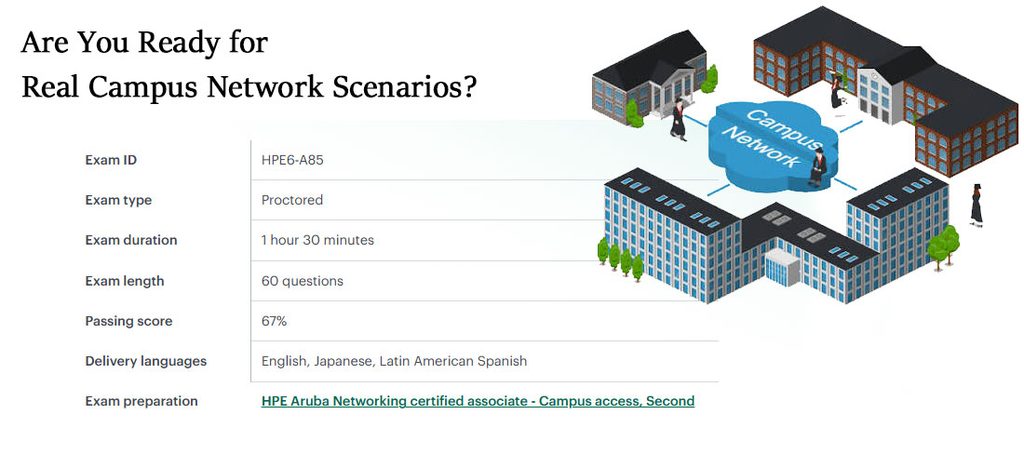
HPE6-A85 is a 90-minute examination with 60 questions, giving candidates an average of 90 seconds per question. Practicing under similar time constraints helps you assess whether you can interpret scenarios efficiently without relying on familiar wording.
A high practice score is encouraging, but it should not be your only readiness measure. You should also be able to explain why the selected answer is correct and recognize what additional information would change your decision.
Combining Official HPE Training With Additional Practice Materials
HPE currently recommends Campus Access Fundamentals, Rev. 26.31, a five-day instructor-led or virtual instructor-led course, for HPE6-A85 candidates.
The official Campus Access certification page provides the current training information.
The course is intended to develop foundational knowledge and practical skills for HPE Aruba Networking campus access. Use it alongside the official exam objectives and relevant technical documentation. Completing a course alone should not be treated as proof of exam readiness.
For candidates who prefer additional question-based preparation, Leads4Pass HPE6-A85 Exam Preparation: (https://www.leads4pass.com/hpe6-a85.html) is another resource to consider. It can be used to review examination-related topics and identify areas that deserve further study.
Before purchasing, check the available materials and compare their coverage with HPE’s current five-section objectives. Pay attention to whether the questions reflect the current examination scope and whether the explanations help you understand the underlying concepts.
Official learning materials establish the technical foundation; practical exercises reinforce configuration and troubleshooting knowledge; additional practice helps expose gaps. These resources serve different purposes, and using them together gives candidates a more useful way to evaluate their preparation.
Conclusion
HPE6-A85 readiness comes down to understanding the work involved in planning, configuring, operating, troubleshooting, and optimizing a campus access solution. General networking knowledge provides a strong foundation, but candidates also need to recognize Aruba-specific workflows and make sound decisions at each stage.
Use the five official exam sections to guide your preparation. Give configuration and troubleshooting the attention their weightings deserve, but do not neglect planning, operation, or optimization. Practice questions are most useful when they reveal what you cannot yet explain or perform—not when they simply confirm that you remember an answer.
